
Most founders already know what an MVP is and how it is supposed to work. You build the smallest version of the product that technically functions, you ship it quickly, and you tell yourself that speed matters more than everything else at the start. The thinking is simple. Get something out, see what happens, and improve it later once users start showing up.
That approach made sense years ago. Today, it breaks much faster than people expect. Users do not give products much time anymore. They open an app, try one or two things, and decide very quickly whether this is worth their effort. If the product feels confusing, slow, or awkward at the moment they need value, they leave. Most of the time, they never come back.
This is where a lot of MVPs quietly fail. Not because the idea was bad, and not because the team couldn’t build, but because the product never felt good enough to use in the moments that mattered.
Where MVP thinking usually fails
An MVP is good at proving one thing. It proves that something can be built. It shows that the team can ship code and that the idea is possible from a technical point of view. What it does not prove is that people actually want to use the product, or that they enjoy using it enough to keep coming back.
If you look closely at failed SaaS products, most of them worked. Features were there. Screens loaded. Data was saved. From the outside, nothing looked broken. But users do not experience features one by one. They experience the flow of the product. They experience how it feels to move from one step to the next, and how much effort it takes to get what they came for.
If that core flow feels heavy or confusing, the product feels broken, even if everything technically works. In a crowded SaaS market, users have many options. They are not going to stay just because you are early or because you promise things will get better later.
What a Minimum Lovable Product really is
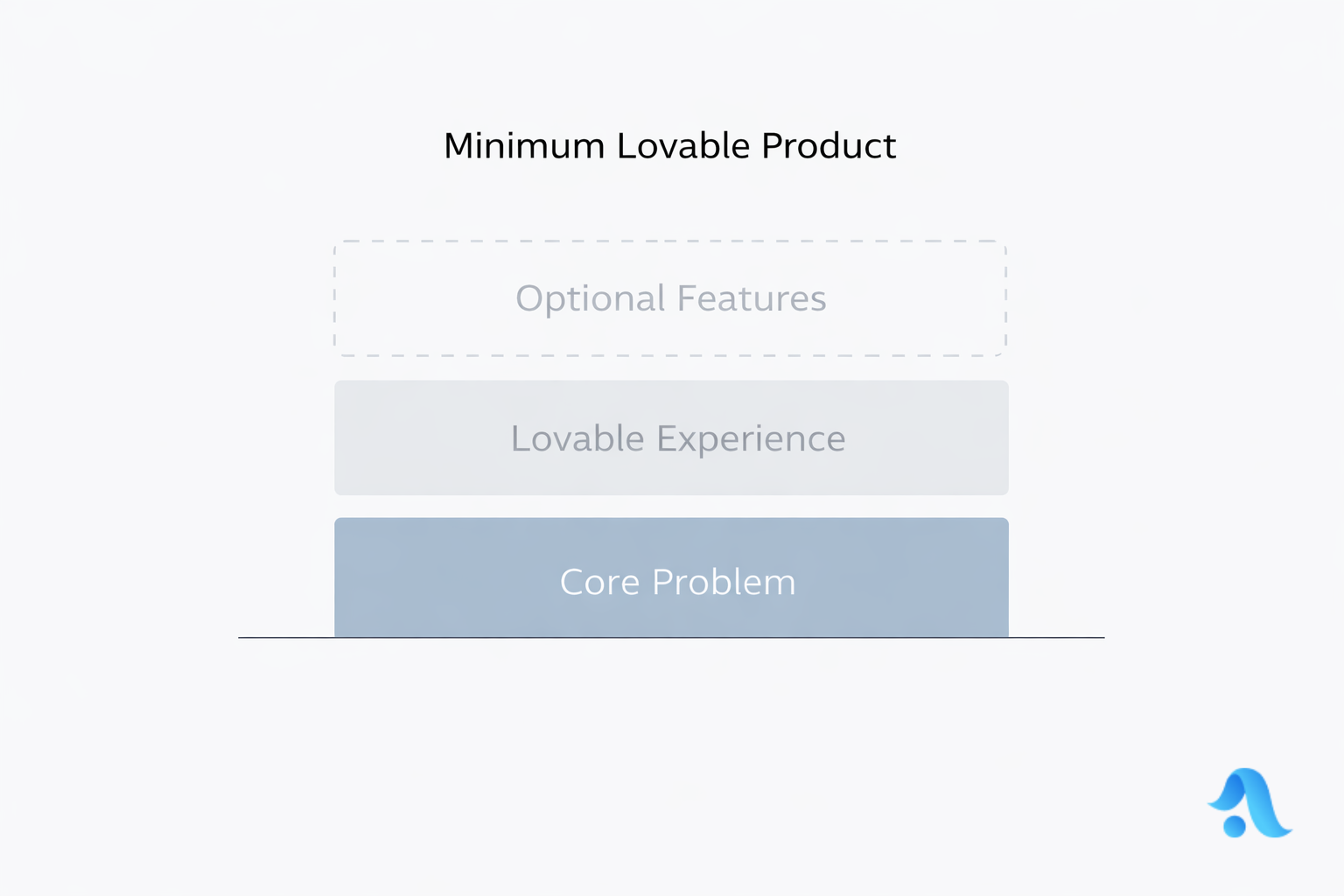
A Minimum Lovable Product is not about adding more features or making a bigger MVP. It is about being very clear on what matters and putting your effort only there. An MLP focuses on one real problem the user actually cares about, one or two key actions that solve that problem, and an experience that feels clear and predictable when someone uses it.
Instead of trying to do many things at once, you narrow the scope and make sure the important parts feel right. You do not add more features to impress people. You make fewer features work smoothly so users do not have to think while using them.
Lovable does not mean fancy design or flashy screens. It does not mean animations everywhere or complex dashboards. It simply means that when someone uses the product, it feels calm. Things behave the way they expect. Nothing feels confusing or out of place. The product helps them instead of fighting them.
Why this matters so early
When users enjoy using a product, their behavior changes in small but important ways. They come back on their own. They explore more. They trust the product enough to spend time with it and slowly build habits around it.
Early traction is not just about getting users to sign up. It is about keeping them and making them comfortable. This is something investors notice as well. A small group of users who genuinely care about the product sends a much stronger signal than a large number of signups who never return.
A Minimum Lovable Product shows that the team understands what users actually need and that they are building with intention instead of guessing or rushing.
How founders build an MLP without slowing down
Many founders worry that focusing on “lovable” means slowing everything down or polishing every small detail. That is not what this is about. The goal is not to make everything perfect. The goal is to focus on the right things.
You start by identifying the moment of value, the exact point where the user gets what they came for. Once that moment is clear, you improve only what leads directly to it. This often means making onboarding simple, making the main action fast, and keeping the behavior of the product predictable so users do not feel lost.
Everything else can wait. An MLP is still minimal. It just means you are careful about where you spend your time and energy.
The mistake founders keep making
A common mistake is hearing the word “lovable” and thinking it means adding more features or doing more work. That usually makes the product worse, not better. Love does not come from complexity. It comes from clarity.
A product with a few smooth actions is always better than a product with many messy ones. The real discipline is not in what you build, but in what you choose not to build yet.
Why Minimum Lovable Products win over time
Products that feel good to use are easier to improve later. Users are patient with missing features if the experience feels solid. They are not patient with frustration. If the product feels painful early on, no roadmap can save it.
A Minimum Lovable Product gives you better feedback, stronger retention, and a much clearer idea of what to build next. It also lowers the risk of big rebuilds because you cared about quality where it mattered most from the beginning.
The real takeaway
Speed still matters, but speed without care no longer works. The founders who do well today are the ones who move fast while being thoughtful about the experience they are creating. They ship small products that users actually enjoy using from the start.
That is what a Minimum Lovable Product really is.