
Technical debt almost never feels dangerous when it starts. In the early days, it feels like progress. Things move faster. Features get added quickly. Small shortcuts feel harmless because everything is still simple and nothing seems to be under pressure yet. It’s easy to tell yourself that you’ll come back later and clean things up once things settle down.
The problem is that later almost never comes.
Most founders don’t realise there is a real issue until the product starts getting used more seriously. Changes that used to take a day now take a week. Small fixes start causing new problems somewhere else. Bugs appear in places that were never touched. At some point, someone says the sentence every founder hopes to never hear, that maybe the whole thing needs to be redone.
By then, the problem is already deep.
What technical debt actually means in real life
Technical debt is not about bad code or lazy work. It usually comes from rushed decisions that made sense at the time but were never revisited. It grows when logic is unclear, when data is handled in different ways across the product, and when new features are stacked on top of old ones without a clear structure underneath.
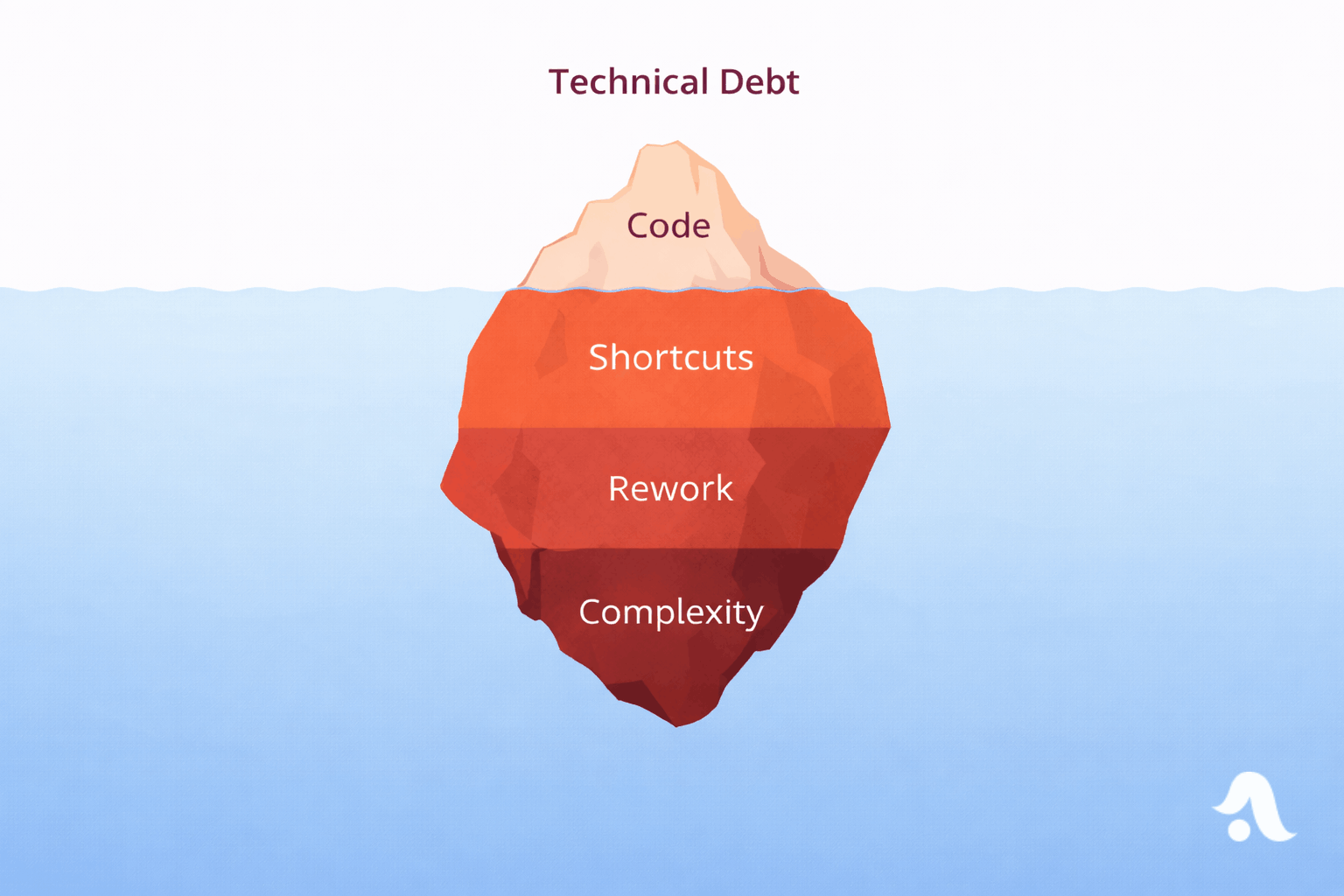
A small amount of this is normal early on. The danger is when it keeps growing without anyone noticing. What hurts is not the shortcut you took last week. It’s the extra work you are forced to do months later because of all the shortcuts taken together.
It’s like borrowing time from your future self without realising how expensive that loan will be.
Why early products are especially vulnerable
Early teams move fast because they feel pressure from everywhere. There is pressure to show progress, pressure to keep users happy, and pressure to move quickly before time and money run out. Founders push for new features. Developers push changes to keep things moving.
In that rush, no one pauses to ask whether the system underneath still makes sense. Pieces get added wherever they fit. Decisions get made just to get past the next problem. Over time, the structure becomes harder to understand and even harder to change.
Teams think they are saving time in the moment. In reality, they are pushing that cost into the future, where it becomes much harder to deal with.
How most technical debt actually forms
Most technical debt comes from doing things in the wrong order. Teams often start by focusing on screens instead of the rules behind them. They add features before the logic is clear. They patch issues instead of stepping back to fix the real cause.
Common patterns show up again and again. Data gets handled differently in different places. There are no shared ways of doing things. Small fixes are made quickly without checking how they affect the rest of the product. None of these choices feel serious on their own, but together they slow everything down.
The product still works, but every change starts to feel heavier than it should.
How founders can reduce these problems early
Avoiding technical debt does not mean overthinking everything or trying to make the product perfect from day one. It means being intentional about a few important things. The core system should make sense before too many features are added. Data should be handled in a consistent way so nothing feels unpredictable. Similar problems should be solved in similar ways instead of inventing something new each time.
When small issues appear, fixing them early is usually cheaper than ignoring them. A clear and simple structure almost always beats clever shortcuts, especially over time. Even very simple products benefit from this kind of discipline.
Why testing and shared rules matter more than founders expect
Many founders see testing as something that can wait. In reality, it protects progress. It gives teams confidence to make changes without being afraid that something important will break. It catches problems before users run into them.
This does not mean everything needs to be tested. What matters is protecting the most important flows, the parts users rely on every day. Shared rules for how work is done matter for the same reason. They make the system easier to understand as more people get involved and prevent every new change from adding confusion.
Without these guardrails, every update adds friction.
Growth exposes what was hidden
A product can survive messy choices when only a few people are using it. Once more people start relying on it, every weakness shows up. Performance issues become obvious. Data problems cause real damage. Edge cases appear everywhere.
This is why many startups stall right when things should start getting easier. Instead of moving forward, the team spends all their time fixing old problems that never should have grown so large.
The way of thinking that avoids painful rewrites
Founders who avoid major rewrites think about speed differently. They don’t chase fast progress at any cost. They focus on stability that allows things to move quickly over time. They understand that small fixes done early prevent large problems later, and that discipline adds up even when it feels slow in the moment.
Thinking ahead does not mean making things big or complex. It means keeping things clean and understandable so growth does not turn into a fight.
The real takeaway
Technical debt is not a developer problem. It is a founder decision problem. The choices made early decide whether growth feels exciting or painful later on. When there is enough care and discipline at the start, the product grows smoothly instead of fighting itself.
That is how strong and scalable SaaS products actually last.